Description
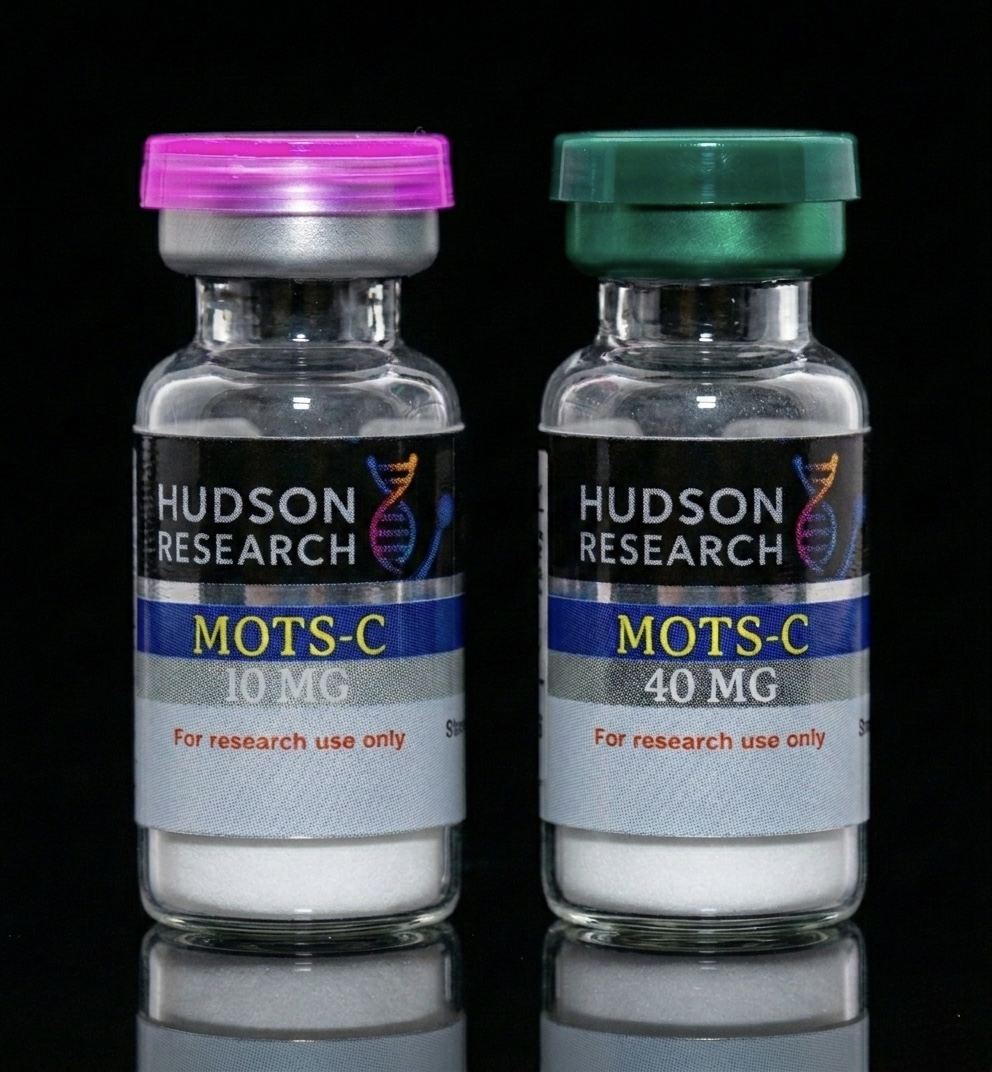
Technical Monograph: MOT-Sc
Product Code: HRL-MOT-10 / HRL-MOT-40 | Tota Mass: 10 mg / 40 mg
Molecular Specification & Composition
| Attribute | Technical Detail |
| Sequence Fragment | Met-Arg-Trp-Gln-Glu-Met-Gly-Tyr-Ile-Phe-Ala-Leu-Ser-Ile-Leu-Trp |
| Molecular Weight | 2174.6 g/mol |
| Purity (HPLC) | >99.0% |
| Available Mass | 10 mg or 40 mg Lyophilized Powder |
| Attribute | Technical Detail |
| Sequence Fragment | Met-Arg-Trp-Gln-Glu-Met-Gly-Tyr-Ile-Phe-Ala-Leu-Ser-Ile-Leu-Trp |
| Molecular Weight | 2174.6 g/mol |
| Purity (HPLC) | >99.0% |
| Available Mass | 10 mg or 40 mg Lyophilized Powde |
Laboratory Application Fields
-
Bioenergetic Homeostasis Research: Investigating the upregulation of GLUT4 and the modulation of insulin-independent glucose transport.
-
Mitochondrial Biogenesis Studies: Analysis of the peptide’s influence on PGC-1$alpha$ and the expansion of the mitochondrial reticulum.
-
Geriatric Cellular Modeling: Evaluation of the peptide’s role in maintaining metabolic signaling integrity in senescent cell populations.
-
Lipid Metabolism Research: Studying the impact of MDP-signaling on fatty acid -oxidation and lipid droplet accumulation.
Storage & Handling Protocols
-
Thermal Management: Store lyophilized vials at -20°C for maximum molecular integrity.
-
Reconstitution: Maintain at 2-8°C post-reconstitution. This 16-amino acid sequence is moderately stable but should be protected from rapid temperature shifts and high-velocity agitation.
-
Handling: Vacuum-sealed to prevent oxidation of the Methionine residues within the sequence.
IMPORTANT NOTICE & DISCLAIMER
FOR LABORATORY RESEARCH USE ONLY. This product is a synthesized chemical reagent intended solely for in vitro laboratory research and analytical testing. It is NOT a drug, food, or cosmetic, and it is NOT intended for human consumption, inhalation, or any form of internal or external application to humans or animals.
Any use of this product outside of a controlled laboratory setting is strictly prohibited. The purchaser assumes all responsibility for the handling, storage, and regulatory compliance of this compound. Hudson Research Lab does not provide medical advice or instructions for human application. Keep out of reach of children.